Nov 29, 2005
We used to have Thanksgiving at our bigger house in Manhattan Beach. Stacey, haute chef that she is, would work with might and main and 20 or so guests would sit at our extended-for-the-holiday table and feast on her accomplishments. She'd do this while holding down her full-time job as public school teacher. Quite amazing.
Those days are gone - We resized our lives and our brownstone apartment can't hold much more than six for dinner, let alone friends and the extended family that have sprung up over the years. . So now we find ourselves guests at other people's tables -- the last few times at Dani and Erik's house. Mike will often fly in and it's become a smaller gathering all over again. That's what happens.
This year we drove up to Clifton Park, Dani and Erik's new hometown near Saratoga, NY. And we brought the turkey with us - we ordered it, weeks before, at the farmer's market that takes place on Saturdays a few blocks away from our house, outside of Prospect Park.

The Prospect Park farmer's market - fruit, veggies and turkeys - fresh-from-the-farm!
Thanksgiving was lovely - Dani set a beautiful table and the new house that she and Erik moved into a few months ago is rapidly becoming a cute and cozy home. After dinner a delicious and belated chocolate birthday cake for Stacey was brought out. Dani had baked it herself and that made me realize once again that we really do become our parents -- she's becoming a baker and cook in her own right, just like Mom. I helped Erik clean the dishes and then we all sat down in the living room while Dani took out her guitar and we sang folk songs and played Balderdash, a fun board game that has you making up false definitions of obscure words. The idea is to bluff the other players into choosing your definition as the "real" one.

Dani at her Thanksgiving table.

Stacey carves the turkey and serves the stuffing.

Surprise! A homemade chocolate cake for Stacey's birthday.

We sat around and sang folk songs to Dani's guitar accompaniment ... "The banks are made of marble with a guard at every door...."
But Thanksgiving festivities were only one of the reasons for our trip up north this holiday weekend. It was also the occasion for the Dutchess County Community College Crafts Fair. Danielle has been making quilts for the past six months. Beautiful, colorful, quilts. She taught herself the art of quiltmaking and set out on a new career. This weekend was the culmination of that gestation period. We came up to help transport her quilts and displays from her home to Poughkeepsie, where the fair was set up on the campus of the school. And we stayed on with her to help her greet customers and sell her wares.
By the time of the crafts fair she had made over 50 of these crib-sized quilts, patchworked from gorgeous fabrics into stunning patterns and designs, some of which took my breath away with their brilliant beauty.
The fair, sadly, was a mixed success. She sold some ten quilts in all, some to friends of ours who came to Poughkeepsie for a fall day's outing but also to lend their support. Still though, a few were sold to casual shoppers attending the fair and looking for holiday gifts. Even though she was disappointed at the number sold, I think it was a good first start in, what many agree, is a rather difficult area of endeavor. More sales would have been nice but, regardless of that, her artistry, competence and sheer energy shone through. That was the accomplishment that impressed me more than anything else.

Quilts, folded, labeled and ready to go -- in Dani's work room.

Dani and Stacey, selling a quilt at the Dutchess Country Community College Crafts Fair in Poughkeepsie.

Many people looked and admired. Not too many bought....Perhaps next time. You might be interested in seeing Dani's quilts yourself. For that, take a visit to her website -- danipress.com. They make a great gift for an expecting mother but can also be used as a cozy lap warmer or decorative wall hanging. Go look.
Nov 17, 2005
My new friend Fred is an interesting guy.
Recently retired from the New York City school system where he worked as a psychologist and looking for something interesting to fill his time, he is now pursuing a lifelong interest by volunteering as a tour guide at the American Museum of Natural History.
"I'd love you to join one of my tours," he said to me recently. I don't like to admit it but I haven't been to that museum since my kids were kids. So I took Fred up on his offer. Fred volunteers once a week on Thursdays and had to undergo rigorous training to be adopted by the museum as one of its tour guides. I met Fred at the museum entrance on West 81st Street, just off Central Park. My friend Bobby joined us also and the three of us walked up to the second floor where Fred would gather the others who were joining his tour.

Fred began his tour in the Theodore Roosevelt Hall - the main entrance to the American Museum of Natural History.
There are some 45 halls in the Museum, housed in 25 interconnected buildings. The museum got its charter in 1860. Its mission -- "To discover, interpret, and disseminate - through scientific research and education - knowledge about human cultures, the natural world, and the universe."
Fred planned, in his hour-and-a-half tour, to cover perhaps four of the halls. The idea was to give us a taste, albeit a small one, of the huge wealth of knowledge that the museum has to offer. For a glimpse of the new Museum, Fred started us off in the Rose Center For Earth and Space. This exciting new addition was built in 1999 and contains the Hayden Planetarium and other exciting exhibits housed in a startlingly modern and beautiful glass cube.

Inside the Rose Center, Fred points out the new planetarium, housed in the Hayden Sphere.

The Beresford (home to Jerry Seinfeld, among others) - as viewed from the Rose Center - Jupiter and Saturn floating in the foreground.

Bob peering into the depths of the universe at the Hayden Planetarium.
Our next hall, and the one for which the museum is so well known, was the Hall of the Dinosaurs. Our tour guide explained the difference between the two main branches of the extinct creatures -- the carnivores and the herbivores and fed us some interesting tidbits of trivia: meat-eaters (the carnivores) have three toes and big heads.Birds, he informed us, have probably descended from that branch of dinosaurs; whereas, the plant eaters (the herbivores) have five toes and small brains. Go figure. Did you know that birds only have three toes?

A Tyrannosaurus Rex's head (the real thing). if you see one of these, er, run fast...in the opposite direction.

These teeth were made for mashing, tearing, crushing...ouch.

Our group examines a big mama T-Rex. Fred told us that it was previously believed tha the T-Rex dragged its tail on the ground to maintain its balance. But new evidence shows it walked on its two giant rear legs and upright with its tail in the air - fearsome!
Next on our tour was the Hall of Biodiversity with amazing displays that revealed the incredible variety of earth's living things. In the center was a life-size recreation of the Dzanga-Sangha Rainforest - with the sounds and smells and lighting of that amazing ecosystem.

Our tour enters the Hall of Biodiversity - so many creatures on this planet earth!
For our final hall, Fred the scuba diver, took us to his personal favorite: the Hall of Ocean Life. Capped by a life-size model of a blue whale, the largest living creature on earth, the hall features interactive computer stations, video displays and realistic dioramas illustrating the creatures and life forms that inhabit the ocean depths. Of particular interest to me were bizarre creatures that provide their own light (bioluminescence) at dark depths greater than 3,000 feet. Some of them looked like living neon signs - incredible!

A model of a Blue Whale hangs in the Hall of Ocean Life - a real one can weigh up to 300,000 pounds! (The model only weighed 29,000 pounds).
The museum is a wonderful place and I regretted having avoided it for so many years. A new exhibit on Darwin opened on November 19th and will run through May 29th of next year. It's ironic that in this age, the exhibit is surrounded by controversy engineered by the right-wing fundamentalists and their political flunkies. The museum, a bastion of science and the scientific method, proudly defends the theory of evolution in the face of attacks by those who would return us to the days of the Scopes Monkey Trial, this time under the pseudo-scientific charade of Intelligent Design. My trip to the museum was brief. I had taken my folding bike on the subway and didn't want to be leaving Manhattan later than 4 p.m., the beginning of rush hour. Taking a bike on the subway is legal but one is expected to be respectful of other riders and avoid travelling during times when the trains are most congested.
I rode through Central Park, wanting to take in a few miles of glory in the heart of the city. It was a beautiful day and the park was filled with glorious fall colors. A great way to end a visit to the Museum of Natural History.

I spied this blazing beauty biking through Central Park on my way to the subway at Columbus Circle.
Nov 14, 2005
My neighborhood was alive with energy and activity -- the grand colors of autumn, which by now are only a memory upstate, are just now beginning to reveal themselves in Brooklyn. The weather was mild with a only a bite of fall chill in the air; the sky was blue and the sun, strong. And the populace was out to take it all in. Cyclists, skaters, runners and walkers, moms and dads with strollers - they were all there, enjoying one of those perfect fall weekends. My Aunt Bea, who long ago migrated to retirement in Florida, has often remarked that the one thing she misses most about living in New York was the change in seasons - the beauty of the changing leaves with their brilliant colors. But besides that, I think, there is an entire set of emotions that we associate with those changes - those feelings must be missing as well or are at least harder to conjure up down there with the absence of seasonal change: the coming of Thankgsiving and the holiday season and the warmth and excitement of pending family gatherings; the abandonment of shorts and t-shirts for long pants, sweaters and coats; the return to school and work after summer vacations and somehow a more serious and busier life after the laid-back days of summer laziness. ......On this particular weekend, we were busy too. Our old friend and director of Camp Kinderland, Alice Shechter, was holding a party to celebrate the marriage of her son Ian to his new bride, Marita. The wedding had taken place this summer in Washington state. Now it was the turn of us east coasters to rejoice. Alice and her boyfriend Lee have a beautiful apartment in Williamsburg with fabulous views of the East River and Manhattan. Williamsburg is one of those "new"-old Brooklyn neighborhoods that has been undergoing a transformation. Artists, young people (and I guess, some old people too) have been moving in over the years and have brought a new life to a moribund section of the city. Of course, the developers have followed the kids, and rents have been going up and up and so have new buildings. The plans for the future look like more of the same - 40-story high rises to line the shores of the East River - a coastline that lay dead and decaying for so many decades. Battles will rage as earlier residents get squeezed out or are forced to live in the shadows of the new Trumpvilles that will rise, wall-like, along the river. For now, though, Williamsburg, is very much alive and a great new place to inhabit or to visit - with an increasing number of restaurants, bars, clubs and shops.

Alice and Lee's loft apartment in Williamsburg - fabulous windows with fabulous views of the East River.

A beautiful spread was laid out to celebrate Marita and Ian's wedding.

Apparently, the food was realllllly good!!

Paul and Judy - discussing world affairs and ... whitefish.

Marita and Ian share some moments with Dennis.

Jody and Paul discuss old times.

Elaine and Lieber Katz - having a good time.

The younger Kinderlanders were there too.

Ora Gladstone, Kinderland's new director, joined in the festivities.

Alice - taking in the festivities - and enjoying it.
Wanna see more photos of the party? Just click here!
......
We left Alice and Lee's around noon - the day was still beautiful so I took my bike out for a few laps around the park. The sun sets early now so the foliage was illuminated by that lovely yellow low-angle light of a late day in autumn. Biking around the park road, the wind rushed in my face, bringing with it the fresh aroma of fallen leaves and grass and the abundance of oxygen given off by Prospect's trees. Being free of car traffic, the only sounds were ones of joy of young kids playing in the park and the gentle hissing sound of my rubber bike tires rolling down the blacktop surface of the park road. Heaven indeed ... right here in Brooklyn.

Who needs the country? Prospect Park is right around the corner - trees, solitude, fresh air and fall colors.

A chance to commune with nature - right in the middle of the city.
 Walk, run, ride, stroll, collect leaves ... just hang out ... Prospect Park is the place.
 Kids out for a ride with dad.
 Volleyball, anyone?
Nov 4, 2005
Blue Ball.
Intercourse.
Bird In Hand.
Lititz!
No, this is not some sort of torrid post about late middle-aged sexual adventures. These are some of the quaint town names in the Amish farm country of Pennsylvania. Some weeks ago in the Times, I read an article in the Escapes section - Amish Country Over the Handlebar. I called Bob Heisler, my old friend from Camp Kinderland days and, like me, an avid bike rider. Had he read the article, I asked. And I thought that was the end of it. I never thought that Bob and I and a third, new-found friend, Fred Reichman, would actually plan and embark on a mid-week jaunt to Lancaster and environs.
And why not? The weather forecasts were predicting unusual-for-late-October 60 degree temperatures and sunny days. The fall foliage had not quite reached as far south as southern Pennsylvania so it looked like it would be perfect for our arrival. Bob made a motel reservation at a Best Western, we downloaded ride sheets from the Lancaster Bike Club and planned our escape from New York for Wednesday and Thursday.
The guys took their bikes and packs on the subway and met at my house where we packed up the Honda van and headed out of the city at about 8:30 on Wednesday morning. The day was glorious, if a bit too windy, as we sped down the Jersey Tunpike connecting eventually to the Pennsylvania Turnpike. On route we perused the various ride sheets and decided on one humorously dubbed The Boisterous Cloister Clomp. This was a "B" ride - not as hard as an "A" ride but harder than a wussy "C" ride. It would take us through pristine Amish farmland with rolling hills, pass through the lovely town of Ephrata (pronounced ef '-rata), whose claim to fame was the Ephrata Cloisters - a Protestant colony whose buildings date back to 1732.
We started our ride at the Conestoga Valley High School, heading north out of the town of Lampeter (pronounced Lamp'-eeter). We turned up a narrow country road that ran off into the distance, intersecting vast farms. The ride description referred to "moderate rolling hills". But moderate hills, when combined with the soon-to-be detested, strong north wind made the going quite difficult. We pushed on, steeping ourselves in the beautiful scenery, passing hard-working Amish farmers cutting the last of their remaining crop stalks and plowing their fields for the next growing season.

Pedalling up Hartman Station Road we had glorious views of farms spread for miles across Conestoga Valley.
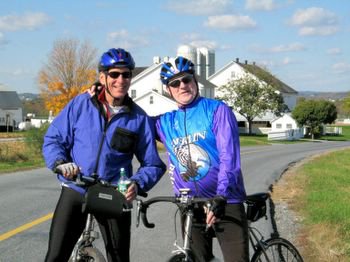
Fred and Bob -- on the road again.
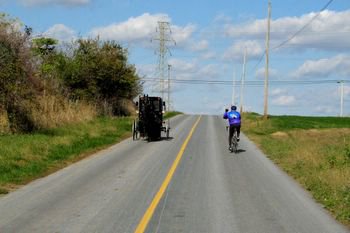
Bob up. Buggy down. We were feeling haimish about the Amish.
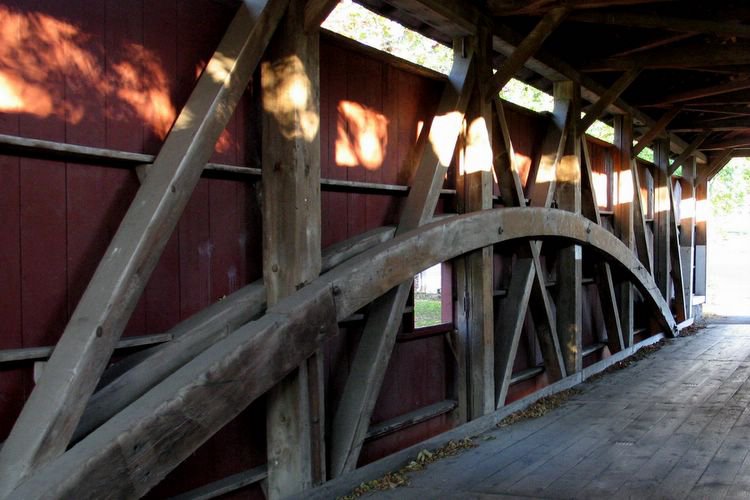
Our route took us through several of the area's famous,old covered bridges. The first bridge took us across the meandering Conestoga River. This was the Bitzen's Mill Covered Bridge. The northeast, in general, and Pennsylvania, in particular, have more covered bridges than other parts of the country. That's because the "frontier" of western Pennsylvania was where the westward expansion was proceeding early on in the history of the young United States. But there were many obstacles, not the least of which were the numerous rivers and streams that crisscrossed the area. Therefore, bridges were needed and as wood was so plenitful and resistant to the vagaries of freezing and thawing (unlike paving stones), it was the obvious material of choice and was used as the superstructure of all these new bridges. On the other hand, wood rots easily. So the early bridge builders simply covered them, thus limiting their exposure to the elements and prolonging their useful lives.

Three bike buddies at the Bitzen Mill covered bridge over the Conestoga River.

The bridges are wide enough for a horse and buggy - but not for two cars, side by side. Lancaster County has 28 covered bridges. From 1820 to 1900, 1500 covered bridges were built in Pennsylvania -- today, there are still 219 remaining!
As we drove further into the countryside, we passed farm after farm belonging to Amish or Mennonite farmers. Here, black garments freshly washed, were flapping and drying in the autumnal sunshine - a strange sight. There, a farmer cut back stalks in his field using a machine pulled by a team of horses. Later that night, lying in bed at the Best Western in Intercourse, we learned from a video on TV that there were several differences between the two sects which had been united but had split over questions of excommunication and the severe practice of shunning. The Amish, followers of Jacob Ammann, split from the Anabaptists in 1693. Ammann believed that the Mennonites were not practicing the ban or shunning as it should be. Thus, his followers are more conservative and stricter in their adherence to their separatist ways: untrimmed beards and hooks and eyes in place of buttons on outer garments of the men; horse and buggy transportation; horse-drawn implements for farming; plain and distinctive dress patterns and no electricity in homes.

A team of horses cuts back the last stalks in this Amish field.
The town of Ephrata was about 15 miles north of our starting point in Lampeter and we were tired from the contstant battle with the north wind. Then too, it was getting late - we had forgotten that the clocks had turned back an hour over the past weekend and that the sun would be setting around five. We didn't want to be on the road after dark. So we took a quick look-see at the Ephrata Cloisters but, even though it looked interesting with its ancient log buildings, decided to pass it by on this trip. We stopped for lunch on Ephrata's Main Street, lined with lovely old homes and 19th century office buildings.
It was three o'clock when we turned our attention to the rest of the ride - we would be heading south this time so the wind would be at our backs. We hoped it would speed us along. But we still had 20 miles to go and only two hours to cover it. A good pace was needed and we were sceptical of succeeding.

Beautiful old buildings on Ephrata's Main Street.

We stopped for hot soup and a sandwich at Oakley's Cafe in Ephrata - nice.
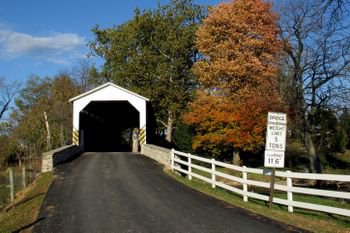
Erb's covered bridge - on our way back.
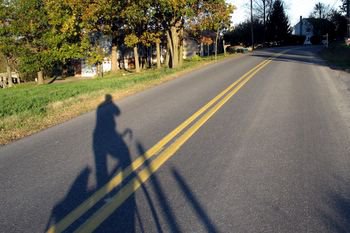
My long shadow. The sun was getting low at 4:30 and we had miles to go.

Still another bridge - the Log Cabin bridge. Note the sophisticated construction using bent timbers for strength.

The sun dips below the horizon - we were almost home.

Fred - tuckered but euphoric from the beautiful day's ride.
We had just a few miles to go when we got held up by a stalled train at a railroad crossing. Dozens of cars were waiting too. After a while, the wheels of the train groaned and it slowly pulled away. The gates opened and we pedalled away, trying to finish before the fading daylight turned to dark.

A blazing red tree set off a monochrome field outside this Amish homestead. The buggy is parked for the night.

Oh no - a stalled train delayed our return ... just a couple of miles to go but the light was rapidly fading.
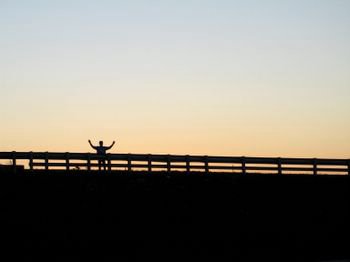
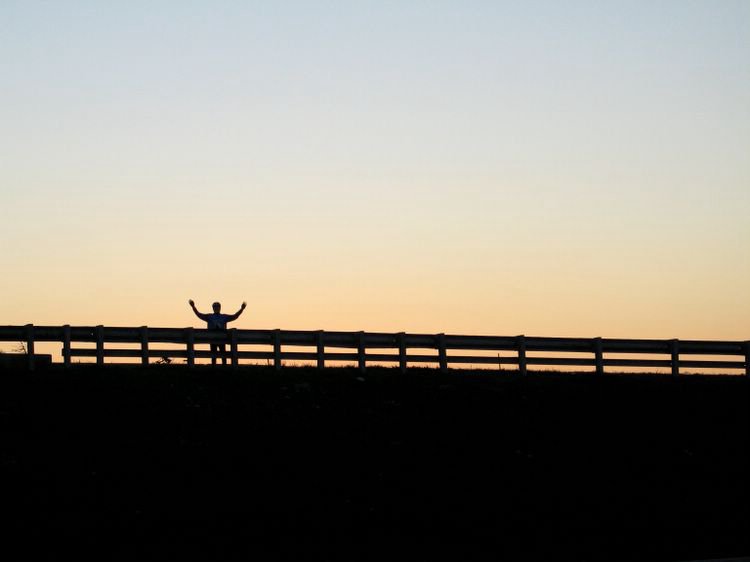
Bob waves to me from an overpass - we're almost back to the car.
We made it - in the nick of time - tired but elated at the beauty of the ride we had taken. Despite the tough going and the struggle to finish before dark, I wouldn't have had it any other way - the magic of the fading light as darkness covered the fields and countryside was as beautiful a sight as you could imagine. The Times article was right in quoting Ernest Hemingway who wrote -- "You have no such accurate remembrance of a country you have driven through as you gain by riding a bicycle."
We drove to our motel and showered up before venturing out for dinner back in Ephrata. The next day we took a short ride around Intercourse - another lovely adventure with great vistas of the surrounding farmland. Then we headed back to the big city - but not before stopping in Lititz (pronounced litt'-its but pronounced by us guys, humorously, with the accent on the last syllable) for a tour of the country's first pretzel factory.
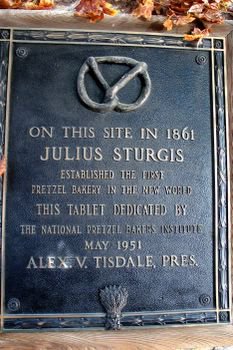
The Julius Sturgis pretzel factory in Lititz, Pennsylvania.

Fred tries his hand at rolling pretzels.

Um, Fred should probably not embark on a pretzel-rolling career.
Our trip was, simply put, a couple of days in Paradise - a glimpse into a community that lives in the past and tries to coexist with present times. Modernity intrudes all around the Amish - subdivisions and rampant commercial development have been built on pristine farmland and, what were once quiet and remote lands, are now plagued with rush hour congestion and malls. I thought to myself that it would not be long before all this was totally gone and that's a tragedy. What is the meaning of progress if it destroys the beauty and serenity of that which came before? My advice --get to see it while you still can.